If you’ve ever watched a maintenance crew clear-cut a 50-meter corridor around power lines, taking down healthy century-old trees to reach one problematic branch, you’ve witnessed exactly what’s wrong with traditional vegetation management. It’s not just wasteful; it’s environmental vandalism disguised as safety protocol.
While utilities struggle to balance fire prevention with environmental responsibility, there’s a quiet revolution happening in vegetation management. Smart grid laser cleaning systems are proving that precision trumps destruction when it comes to maintaining power infrastructure without sacrificing our urban canopy.
The environmental cost of “safety first”
Let’s talk about what traditional vegetation management actually does to our environment:
Carbon impact: A mature tree can sequester 22 kg of CO2 annually. When maintenance crews remove entire trees instead of targeting problem branches, we’re not just losing current carbon absorption—we’re releasing decades of stored carbon back into the atmosphere.
Urban heat islands: Every tree removed from suburban corridors increases local temperatures. In Australian cities already struggling with extreme heat events, this over-clearing contributes to the urban heat island effect that makes our summers increasingly unbearable.
Biodiversity loss: Traditional clear-cutting approaches destroy nesting sites, wildlife corridors, and established ecosystems. What grows back isn’t the same—it’s usually fast-growing, shallow-rooted species that provide less environmental benefit.
Soil erosion: Removing entire root systems destabilises soil, particularly on slopes and embankments where power lines often run. This leads to erosion, water quality issues, and the need for expensive remediation work.
The irony? Most of this environmental damage is completely unnecessary. The problem is usually one or two branches—not the entire tree.
Precision over destruction: the laser advantage
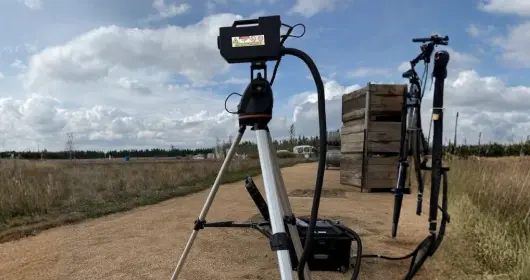
Here’s where laser technology changes everything. Instead of approaching vegetation management with the subtlety of a bulldozer, precision laser systems can target individual branches with surgical accuracy.
Surgical targeting: The laser system can identify and remove specific branches that pose risks to power lines while leaving the rest of the tree intact. This means a 100-year-old eucalyptus keeps 95% of its canopy and continues providing environmental benefits.
Minimal ecosystem disruption: Wildlife habitats remain largely undisturbed. Birds don’t lose nesting sites, and wildlife corridors stay connected. The ecosystem adapts to minor branch removal rather than being completely destroyed.
Carbon preservation: By maintaining tree health instead of removing entire specimens, we preserve existing carbon storage while allowing continued CO2 absorption. The climate benefits compound over time.
Natural regeneration: Precision cutting mimics natural pruning processes. Trees respond better, heal faster, and often develop stronger branch structures that require less future intervention.

The climate business case
Beyond environmental stewardship, precision laser management makes compelling business sense in our climate-conscious world:
Carbon accounting: Utilities increasingly need to demonstrate carbon neutrality. Preserving existing trees instead of clear-cutting provides measurable carbon offset benefits that contribute to sustainability targets.
Climate adaptation: As extreme weather events increase, maintaining robust urban canopies helps cities adapt to temperature extremes. Utilities that preserve tree cover are investing in community resilience.
Regulatory compliance: Environmental regulations are tightening. Precision management helps utilities meet vegetation management requirements without triggering environmental impact assessments required for large-scale clearing.
Community relations: Nothing damages utility-community relationships like unnecessary tree removal. Precision laser management demonstrates environmental responsibility while maintaining safety standards.
Real-world environmental outcomes
Early adopters of precision laser vegetation management are documenting significant environmental benefits:
Tree preservation: 85% of trees that would have been removed under traditional protocols remain healthy and intact with targeted branch removal.
Carbon impact: Preliminary studies suggest 70% reduction in carbon release compared to conventional clear-cutting approaches in the same corridors.
Ecosystem recovery: Wildlife monitoring shows faster ecosystem recovery in laser-managed areas, with bird populations returning to normal levels within one season versus 3-5 years for clear-cut areas.
Soil stability: No measurable soil erosion in precision-managed corridors compared to 15-30cm of topsoil loss in traditionally cleared areas over five-year periods.
Beyond trees: Precision environmental management
The environmental benefits extend beyond individual trees:
Native vegetation: Precision removal preserves native understory plants that would be destroyed by heavy machinery access. These plants are often more environmentally valuable and harder to replace than the problem branches above them.
Water quality: Maintaining root systems prevents sediment runoff into waterways. This is particularly crucial in catchment areas where power line corridors cross sensitive water supplies.
Microclimate preservation: Keeping most tree canopy intact maintains local microclimates that support diverse plant and animal communities.
Chemical reduction: Precision management reduces the need for herbicide treatments often required after traditional clearing to prevent regrowth.
Climate resilience through smart infrastructure
As climate change intensifies, our infrastructure needs to be both resilient and environmentally responsible. Precision laser vegetation management supports both goals:
Extreme weather adaptation: Healthy, properly pruned trees are more wind-resistant than stressed trees trying to recover from heavy cutting. They’re also more drought-tolerant with intact root systems.
Fire prevention: Targeted removal of dead wood and problem branches actually improves fire safety compared to clear-cutting, which often leaves flammable debris and encourages fire-prone regrowth.
Temperature regulation: Maintaining tree cover along power corridors helps moderate local temperatures, reducing thermal stress on electrical equipment while providing community cooling benefits.
Making the environmental business case
For utilities ready to lead on climate responsibility:
Sustainability reporting: Precision vegetation management provides concrete metrics for environmental impact reduction in annual sustainability reports.
Carbon offset value: Preserved trees represent quantifiable carbon assets that can contribute to net-zero targets.
Community partnership: Environmental stewardship builds community support for necessary infrastructure projects and rate adjustments.
Regulatory advantage: Proactive environmental management positions utilities favourably with increasingly strict environmental regulations.
Implementation without revolution
The transition to climate-smart vegetation management doesn’t require overhauling existing operations:
Pilot programs: Start with environmentally sensitive areas where traditional methods face community opposition or regulatory challenges.
Hybrid approach: Use precision laser technology for targeted interventions while maintaining conventional methods where appropriate.
Environmental partnerships: Collaborate with local environmental groups to identify priority areas for precision management trials.
Measurement and documentation: Track environmental outcomes to build the business case for expanded precision management programs.
The future of environmental infrastructure management
Climate change isn’t waiting for utilities to figure out how to balance safety with environmental responsibility. The utilities that master precision vegetation management now will be the ones thriving in a carbon-constrained future.
This isn’t about choosing between safety and environmental stewardship—it’s about using 21st-century technology to achieve both. Every tree preserved, every ecosystem protected, and every ton of carbon kept out of the atmosphere represents a competitive advantage in our climate-conscious world.
The question is whether your utility wants to be known for environmental leadership or environmental destruction. Because with precision laser technology available, there’s no longer an excuse for the latter.
Curious about how this would work for your specific situations? Let’s talk about a pilot project that addresses your biggest maintenance headaches without disrupting your current operations. Simply drop us a line here.